Whether you’ve written a blog or delved into keyword research, you’ve likely dealt with seed keywords. Finding and developing an extensive seed keyword list is the very first step toward an effective keyword research process — making a strong pillar for your content strategy. Seed keywords are important because they serve as the foundation for building topical authority, organizing content, and guiding your overall SEO efforts.
Seed keywords are also foundational for digital marketing and marketing strategy, helping to align your SEO approach with broader business objectives and content planning.
So what exactly is a seed keyword list? A good seed keyword is typically brief, highly relevant to your niche, and has a reasonable search volume, making it an ideal starting point for keyword research. And how do you put together a keyword strategy that will raise your ranking for important keywords? And once you have your seed keywords, what do you do next?
In simple terms, seed keywords are short tail keywords, usually one or two-word keywords that describe a topic broadly that is relevant to the searches for which a business would like to rank. One seed keyword can serve as the starting point for your keyword research process. Finding these overarching keywords provides a starting point to dig into more specific terms and phrases to draw in customers who are trying to find answers to specific questions.
These more specific keywords can vary greatly in length but are generally referred to as long-tail keywords. A tail keyword is derived from a seed keyword by expanding it into more detailed, specific search queries. These can include common questions related to the relevant topic, phrases that are associated with that topic, and even terms and phrases that are relatively synonymous with other keywords on a list.
So when you look to establish a seed keyword strategy for your SEO projects, what you’re doing is finding the terms for the big picture elements of your product or your service. It is important to focus on relevant seed keywords to ensure your strategy targets the right audience. That may sound simple, but it takes more work than you might think.
This is because important seed keywords won’t necessarily show up if you limit your seed keyword compilation process to the terms that your team can think up in a brainstorm session. To develop an effective list, you need to dig deeper than that. You can find seed keywords and select seed keywords for your strategy by using methods such as competitor analysis, keyword research tools, SERP analysis, and exploring related search suggestions.
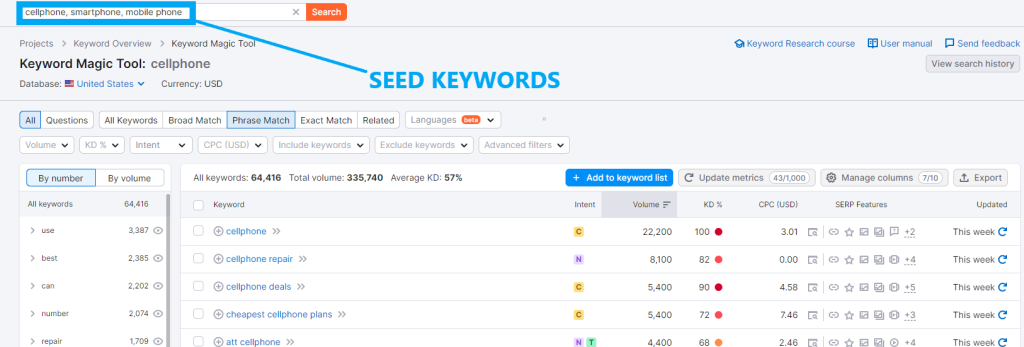
Once you have an understanding of what a seed keyword is, you can begin to compile lists relevant to your brand, products, and services. The quality of your seed list will directly affect the quality of your keyword research and mapping, so it is important to be thorough.
You already know some of the general terms that are important to your industry. Those can be a good place to start. But you will also want to look at your own website. By going over your established web presence, some keywords that you hadn’t yet thought of may jump out at you.
After you have looked over your website with an eye focused on seed keyword discovery, you are almost ready to look elsewhere. Before you look outside your own website, you should run it through a website crawling tool.
One of these tools will go through, not just your page titles and headings, but through the metadata and meta descriptions of your website. That crawl will provide a very thorough list of keywords for you to choose from. You won’t necessarily want to use all of the website crawler’s keywords, but there are bound to be some great ones there that you missed. You can also use a research tool or keyword tool, such as Google Keyword Planner, to generate a list of seed keywords and analyze keyword metrics like search volume and keyword difficulty.
But that’s just the beginning. You can apply that same process to your competitors’ websites. Use your crawler to dig into their meta descriptions and look for keywords that you haven’t been using or that they are using more prominently than you.
By understanding what keywords your competitors utilize, you can gain insights into how they are able to attract their customers. Identifying your competitor’s seed keywords and analyzing their ranking keywords can reveal valuable opportunities for your own SEO strategy. You can then use that information to try to reach that pool of customers first.
This is not to say that you should automatically include any keyword you find on a competing site as a seed keyword. Your competitor may not have an SEO optimized page or they may be using poor keywords that they don’t rank for. Evaluate potential keywords and potential seed keywords to ensure they align with your goals and audience.
Be aware of the quality of the websites you examine. And keep in mind that your SEO competition may come from different websites than just your competitors’ official company websites.
To maximize your SEO efforts, focus on finding more seed keywords and additional seed keywords by exploring related searches, autocomplete suggestions, and the People Also Ask section to expand your list of seed keywords.

Looking at your web presence and the websites of your competitors is just one of several ways to find items for your seed keyword compilation. Those keywords will cover many industry terms, but what about the terms used by your customer base?
The chances are good that your customers don’t have the in-depth knowledge of your business that you do, so they may not know enough to search using common industry terms—they may have a problem and not know the exact phrases that the solution can be found through.
So how do you, someone who is not a layperson in your field, figure out how a layperson would search for your products? The simple answer is you let the search engines themselves tell you what you want to know.
When you search for a keyword, you get your search engine results page—your SERP. Your SERP will show you the organic results of your search, but you can also look at the people who ask (PAA) results.
The PAA on a given search will show you similar and related search terms used by other people making similar and related searches. This can include searches for basic information on a topic or more detailed questions than your initial search asked.
Your SERP will also give you a list of related searches. If you run a search using an umbrella term for a service you provide, the related searches will show up with more granular keywords that touch on more specific aspects to that service.
Additionally, using Google Ads and its Keyword Planner tool allows you to find long tail keywords and relevant long tail keywords by analyzing search volume and generating keyword ideas for both SEO and paid campaigns.
But even before you get to your SERP, your search engine of choice can provide you with some valuable seed keyword options. As you type your keyword into the search bar, you will get a list of autosuggestions. Google suggests related search terms in the autocomplete, ‘People also ask’, and related searches sections, which can be used as seed keyword ideas to expand your content strategy.
These methods help you find long tail keywords and generate seed keyword ideas that are directly relevant to your products, customers, and competitors.


There are great external sites like Quora, Reddit, or niche forums that are great places to look for goldmines of information. This option is great for businesses in industries that are relatively new and haven’t adopted for search yet, or industries so niche that there aren’t a lot of keywords out there. You can use search operators to find web pages related to your industry or seed keywords you are trying to expand on, such as ‘social media marketing’ or ‘digital marketing’.
In the following example, we are using the search operator “site:reddit.com” to make sure we only see results from Reddit and then I put my keyword in quotation marks which will find exact match results that contain it. For instance, searching for “social media marketing” as a seed keyword can help you discover relevant discussions and additional keyword ideas. You can also try “site:reddit.com intitle:keyword”, which would only show posts that have the keyword in the title. Besides those two options, you can play with search operators to find even more results and information.

When it comes to building a powerful seed keyword list, analyzing your competitors is one of the smartest moves you can make. Your competitors are already investing in keyword research and SEO strategy—so why not learn from their successes and gaps? By examining the keywords that are driving traffic to their websites, you can uncover seed keywords and keyword ideas that you might have missed, and spot opportunities to outperform them in search engine rankings.
Start by identifying your main competitors—these could be businesses offering similar products or services, or even content creators targeting the same audience. Once you have your list, dive into their websites and content. Pay close attention to the keywords they use in their page titles, headings, and throughout their content. This can give you a sense of the broad seed keywords and more specific keyword phrases they’re targeting.
To take your analysis further, leverage keyword research tools like Google Keyword Planner, Ahrefs, or SEMrush. These SEO tools allow you to analyze competitors’ keywords, see which terms are bringing them the most traffic, and discover related keywords you may not have considered. Look for keywords with a healthy monthly search volume and manageable keyword difficulty—these are often the right seed keywords to add to your own list. Don’t forget to check the keywords tab or queries tab in tools like Google Search Console to see which relevant search queries are driving traffic to your competitors.
Beyond just keywords, examine your competitors’ content strategy. What types of content are ranking well in search results? Are they focusing on long tail keywords, or do they dominate for short tail, high-volume terms? Use research tools like BuzzSumo to see which pieces of content are getting the most shares and engagement on social media. This can help you generate related keywords and new keyword ideas that align with your target audience’s interests.
As you analyze competitors’ seed keywords, keep an eye out for gaps—relevant keywords or specific long tail keywords that your competitors aren’t targeting, but that have potential search volume and align with your business. These represent opportunities for you to create content and rank for queries your competitors may have overlooked.
Remember, the goal isn’t just to copy your competitors’ keyword list, but to use their strategies as inspiration to uncover seed keywords and refine your own SEO strategy. By combining competitor insights with your own brainstormed seed keywords and research, you’ll build a comprehensive seed keyword list that supports your content creation efforts and helps you climb the search engine rankings.
Always keep your target audience and their search intent at the center of your keyword research process. The more relevant and valuable your seed keywords are to your audience, the more effective your content will be in attracting and engaging visitors.
So you’ve gone through your website, you’ve brainstormed with your team, you’ve looked through your competition’s keywords, and you’ve examined the kinds of keywords your audience is likely to be directed towards by their search engine of choice. So how do you organize all the seed terms you’ve compiled?
You could list your seed keywords in a text document, but that wouldn’t be the most efficient way to look through them. A spreadsheet is your best bet because the spreadsheet will help you accommodate information from your further keyword research.
You can then add information about minimum and maximum volume for each seed keyword, as well as identifying keywords for which you already rank. Be sure to include keyword metrics such as search volume and keyword difficulty for each seed keyword, as these metrics help you evaluate and prioritize your list of seed keywords more effectively. Information about the competitiveness of the keywords on your seed list.
The more information you can find and apply to your seedlist, the better you can utilize those keywords. Then you can sort your list depending on the vector you want to prioritize with your SEO strategy.
These are the basics when it comes to a “how to build a keyword list” breakdown. The seed keywords you identify give you the raw materials to develop your keyword research and map your keywords to your web pages.
By taking your seed keyword compilation seriously and pairing it with quality information regarding keyword volume, difficulty, and ranking, you can put your SEO strategy on the right path to improve the web traffic that comes through your websites.
In order to make the most of your seed keywords, though, it’s a good idea to work with people who know SEO inside and out. At WiRe, we have spent years honing our strategies for SEO optimization and deployment.
If you are ready to get more traffic on your website, WiRe Innovation is ready to help you. Contact us today!